Heat Pump for a Seattle Condo: What Works, What's Allowed, and What It Costs
Can you put a heat pump in a Seattle condo? Yes. Here's what Washington's HOA law allows, where the outdoor unit goes, permits, and 2026 cost after rebates.
Can you put a heat pump in a Seattle condo?
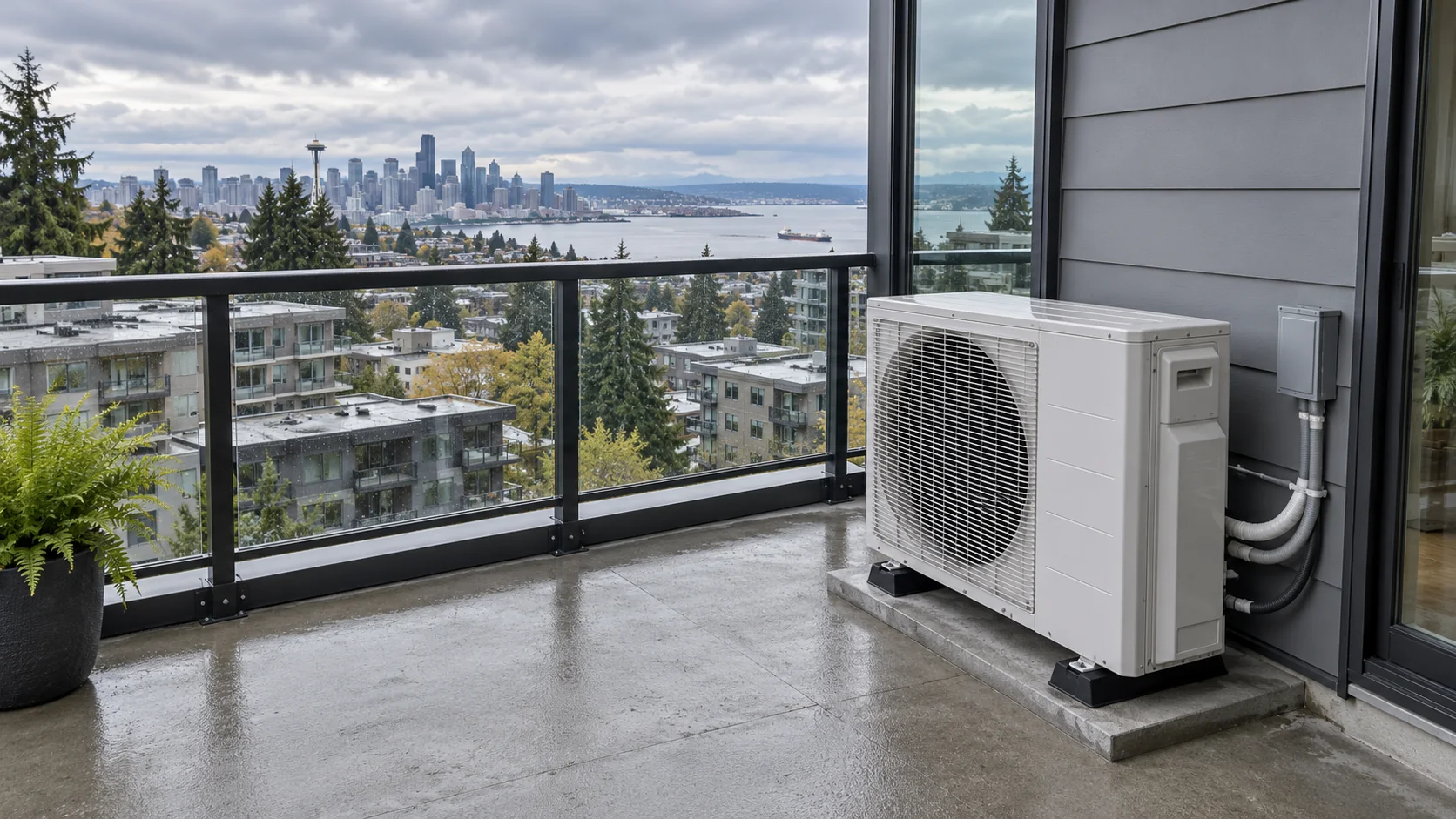
Yes, you can put a heat pump in a Seattle condo, and for most units the answer is a single-zone ductless mini split with the outdoor unit on your balcony or an exterior wall. The hard part is not the equipment. It is your HOA, your electrical panel, and finding a legal place for the outdoor unit.
This guide is for condo owners in Seattle who are tired of paying for baseboard heat with no air conditioning, and for HOA boards fielding the same request from three different owners. It covers what systems actually fit a condo, what your HOA will ask for, how the outdoor unit gets placed, what the City of Seattle requires, and what it costs in 2026 after rebates.
Why Seattle condos are uncomfortable in both directions
Most Seattle condos built before about 2015 were designed for a climate that no longer exists: heat only, no cooling, and a lot of glass. The typical setup is electric baseboard or Cadet-style wall heaters in each room, a line-voltage thermostat, and nothing at all for summer.
That combination fails on three fronts:
- Winter bills. Electric resistance heat turns one unit of electricity into one unit of heat. A heat pump delivers roughly three units of heat for the same electricity in Seattle's mild winters. Seattle City Light estimates heat pumps cut heating costs 25 to 50% against standard electric heat.
- Summer heat. South- and west-facing units in Belltown, South Lake Union, Capitol Hill, and First Hill routinely hit the high 80s indoors during a July heat event. Floor-to-ceiling glass on a concrete slab stores heat all day and releases it all night. A box fan and open windows do not fix that.
- Noise and air. Opening windows for relief means traffic noise, wildfire smoke in late summer, and pollen. A heat pump with the windows shut is quieter and filters the air.
Is your condo a good candidate?
If your unit has baseboard heat and no cooling, you are the ideal condo heat pump candidate. If you already have a central system fed by the building (common in newer towers), skip to the shared-system note in the options section below.
Can my HOA say no? Washington law since 2024
Your HOA cannot ban heat pumps, and it has 60 days to answer your application or it is deemed approved. Washington passed ESSB 5973 in 2024, and it added a heat pump section to every condo and HOA statute in the state, including older buildings governed by the pre-2018 Condominium Act. The WUCIOA version is RCW 64.90.580.
What the law says, in plain terms:
| Rule | What it means for you |
|---|---|
| No effective prohibition | The association cannot adopt or enforce a rule that bans heat pumps or restricts them so much that installing one becomes impractical. |
| Reasonable restrictions allowed | They can require professional installation, sound-rated equipment, screening, specific mounting methods, and placement that does not block walkways or egress. A restriction is unreasonable if it significantly raises cost or cuts efficiency. |
| Inside your unit boundary | The right applies to equipment within your unit, which usually includes a limited-common-element balcony or deck. Equipment on a true common element (roof, exterior wall, garage) still needs board approval, which cannot be unreasonably withheld. |
| 60-day clock | A written application that is not denied in writing within 60 days is deemed approved, unless the board reasonably asked for more information. |
| No installation fee | The HOA cannot charge you a fee for installing a heat pump. It can charge only its normal architectural-review processing fee, and only if it charges that for every modification request. |
| Licensed HVAC contractor required | You must agree in writing to use an HVAC contractor who will assess the building's existing infrastructure, identify what else is needed, and do the install. |
| You own the maintenance | You and every future owner of the unit are responsible for inspection, repair, replacement, damage, and removal. As of June 11, 2026, the governing documents cannot shift that onto the association. |
What a complete HOA application looks like
What a complete application looks like. The boards that approve fastest get the same packet every time:
- A one-page cover letter citing RCW 64.90.580 (or the matching section for your statute) and stating you agree in writing to the three conditions in subsection 4.
- The contractor's proposal with model numbers, a sound rating (dB) for the outdoor unit, and the electrical scope.
- A marked-up photo or sketch showing where the outdoor unit, line set, and condensate drain go, and what the exterior will look like.
- Proof of contractor license, bond, and insurance, plus a copy of the Seattle permit application once filed.
- A maintenance acknowledgment saying you will service the unit annually and cover any damage.
Preparing the packet with Mogovolt
Mogovolt prepares this packet as part of every condo bid. We have found that boards that see it done properly once usually turn it into a building standard for the next owner.
Which heat pump actually fits a condo
For nine out of ten Seattle condos, the right answer is a single-zone ductless mini split: one wall-mounted indoor head in the main living space, one compact outdoor unit on the balcony. Larger units and townhouse-style condos sometimes justify a second zone for the primary bedroom. Everything else is a fallback for when you cannot place an outdoor unit.
| System | Where it fits | Heating performance | Typical drawbacks |
|---|---|---|---|
| Single-zone ductless mini split | Studios through 2-bedroom units with a balcony or an approved exterior wall spot | Full heating and cooling to well below Seattle's design temperature; cold-climate models hold capacity at 5 degrees F | One head serves the open living area; bedrooms with closed doors run a few degrees different |
| Multi-zone ductless (2 to 3 heads) | 1,200 sq ft and up, or when bedroom comfort is a must | Same as single-zone, each room on its own thermostat | Longer line-set runs through finished walls; higher cost; more HOA scrutiny |
| Floor-mounted or ceiling-cassette head | Units with full-height glass where a wall head has no wall to sit on | Same as a wall head | Ceiling cassettes need ceiling depth most slab condos lack; floor units take up footprint |
| Through-wall packaged terminal heat pump (PTHP) | Buildings with existing through-wall sleeves, or where no outdoor placement is possible | Adequate for a single room; most models fall back to electric resistance below about 25 to 30 degrees F | Noisier indoors, lower efficiency, needs a 16 by 42 inch wall opening and a wall sleeve, visible exterior grille |
| Window or saddle-style heat pump (120 V) | Renters and owners who cannot modify the building at all | Heats and cools one room; capacity drops in the 20s | Blocks part of a window, not a permanent fix, limited to roughly 400 to 500 sq ft |
| Building-wide VRF or water-source system | Newer towers where the building already owns a central plant | Excellent when it exists | Owners cannot install this individually; it is an HOA capital project |
Cold-climate equipment and indoor head placement
Two notes specific to Seattle:
- Cold-climate models are worth it. Seattle's heating design temperature is in the low 20s, and recent cold snaps have dropped into the teens. A standard mini split loses a third or more of its rated heat output at those temperatures. A cold-climate model (look for a rated output at 5 degrees F on the spec sheet) keeps the baseboards off all winter instead of just most of it. We leave the existing baseboards in place as backup unless the HOA or electrical scope requires removal.
- Keep the heads off the glass wall. Heads mounted on an interior wall facing the windows throw air across the room toward the glass, where the heat gain and loss actually happen. Mounting them above or next to the glass tends to short-cycle the unit.
Ductless systems in other Seattle home types
The ductless approach also suits Seattle Craftsman homes without ductwork and ADUs and DADUs, although condo approvals and installation costs are different.
Where the outdoor unit goes
The outdoor unit placement decides whether a condo heat pump is a $6,000 job or a $12,000 job, and it is the question your HOA cares about most. Here are the placements we see in Seattle buildings, from easiest to hardest.
- On the balcony or deck, on a stand or vibration pad. The default. The balcony is usually a limited common element you have the right to use, so the equipment stays within your unit boundary for purposes of the heat pump law. A compact single-zone condenser is roughly 21 by 31 by 11 inches and sits on a 12-inch stand against the wall. Most boards accept this if it is not visible from the street and does not block the egress path.
- On an exterior wall bracket outside the balcony rail or below a window. Common on older walk-up condos. This is almost always a common element, so the board must approve it, but the law says approval cannot be unreasonably withheld. Expect requirements for a stainless bracket, through-bolts with the envelope sealed by the contractor, and a color-matched line-set cover.
- Ground level next to the building. Low-rise garden-style condos. Needs a pad, a condensate path, and attention to the Seattle noise limit at the neighboring property line (see the permit section).
- On the roof. Mid- and high-rise buildings with no balconies. Technically possible, but line-set length limits (typically 65 to 100 feet for a single-zone unit, including vertical rise) rule it out for all but the top two or three floors. Roof penetrations also mean a roofer, a structural check, and usually a waterproofing warranty conversation.
- In a parking garage or mechanical room. Occasionally workable in buildings with ventilated garages, but condensers need airflow and heat rejection. Enclosed, unventilated spaces do not work.
Routing the line set and condensate drain
The line set (two insulated copper refrigerant lines, a drain line, and the control cable) runs from the outdoor unit to each head through a 3-inch core hole in the exterior wall. In a concrete building that hole is the single most consequential part of the job: it is almost always a common element, it needs a coring contractor, and the board will want to see how it is sealed. We route line sets through a painted exterior cover or inside a chase where one exists, and we locate the hole so the exterior cover is as short as possible.
Condensate from the indoor head has to go somewhere. In a condo that is usually a small condensate pump to a bathroom or kitchen drain, or a gravity drain out through the same core hole to the balcony. Dripping onto a neighbor's balcony is a fast way to lose HOA goodwill, so we never discharge over a rail.
Electrical: the question nobody asks until bid day
A single-zone mini split needs a dedicated 240-volt circuit, usually 15 or 20 amps, from your unit's panel to a disconnect at the outdoor unit. Most Seattle condo panels built after 1980 are 100 or 125 amps and have room. The trouble shows up in three situations.
- Full panels. Older units with a 60- or 70-amp panel, or a 100-amp panel that already feeds an electric range, dryer, water heater, and baseboards on every wall. Removing or de-rating the baseboard circuits often frees the capacity. The National Electrical Code allows a load calculation on existing demand (Seattle adopts NEC 220.87) which usually shows plenty of headroom once the baseboards are counted as replaced rather than added.
- Panel location. Many condos put the panel in a hall closet or kitchen wall on the opposite side of the unit from the balcony. The new circuit has to get across a finished ceiling or slab. Surface raceway, running the wire inside the line-set cover, or going up through a closet are the usual options.
- Building-side limits. In some towers the unit feeders come off a shared meter bank with limited capacity, and the building engineer or the HOA's electrical consultant has an opinion about adding load. The heat pump law specifically requires your HVAC contractor to assess existing infrastructure for this reason. We request the building's one-line diagram when one exists.
Keeping electrical work in the quote
Mogovolt is an electrical contractor as well as an HVAC contractor, so the circuit, disconnect, any panel work, and the Seattle electrical permit are part of our scope rather than a separate sub you have to coordinate. That is worth asking any bidder about: a mini split quote that does not list the electrical permit number is not a complete quote.
Permits and the Seattle noise rule
Every split-system heat pump in Seattle needs a City of Seattle refrigeration permit, and only a licensed refrigeration contractor can pull it. SDCI's own guidance is that a refrigeration permit is required for any split heat pump or job with refrigerant piping. The electrical circuit gets its own electrical permit. Both are issued through the Seattle Services Portal, usually within a couple of days, and both get inspected: a cover inspection before the line set is concealed and a final.
A contractor who offers to skip the permit is offering to make your heat pump unpermitted work that shows up at resale and voids the HOA approval you just obtained under a law that requires permits. Walk away.
Noise. Seattle's noise code, SMC 25.08, limits sound from residential equipment to 55 dBA at the neighboring property line during the day and 45 dBA from 10 p.m. to 7 a.m. SDCI states that ductless systems do not normally need a noise review, but they must still comply if a neighbor complains. In a condo the "neighbor" is often the balcony 8 feet away, and the HOA will set its own expectation regardless of the city rule.
What keeps a condo install quiet:
- Pick a condenser rated 50 dBA or lower at the unit. Most current single-zone cold-climate models are in the 45 to 52 dBA range at full speed and far lower at the part-load speeds they run at most of the year.
- Set it on rubber isolation feet or a pad, never bolted hard to a concrete balcony slab that carries vibration into the unit below.
- Keep the fan discharge pointed away from the nearest neighboring balcony and off a hard reflective wall if the layout allows it.
- Enable the quiet-mode schedule most manufacturers build in, which caps fan speed overnight.
Documenting the sound rating
We include the manufacturer's sound rating and a one-page siting note with every condo permit application so that both the board and the city see it has been addressed.
What a condo heat pump costs in Seattle in 2026
Plan on $5,500 to $8,500 installed for a single-zone cold-climate mini split in a condo with a balcony and a panel that has room. The condo premium over a house is real but modest: the core drill, the line-set cover, the HOA packet, and the balcony stand add roughly $800 to $1,500 compared with a ground-level install on a single-family home.
| Scenario | Installed range (approximate) | What drives it |
|---|---|---|
| Single-zone, balcony placement, panel has capacity | $5,500 to $8,500 | 9,000 to 12,000 BTU cold-climate unit, one core hole, 20-amp circuit |
| Single-zone plus panel work or long circuit run | $7,000 to $10,500 | Baseboard circuit removal, sub-panel, or 40-plus feet of raceway |
| Two-zone ductless | $10,000 to $15,000 | Second head, branch box or dual-port condenser, longer concealed line sets |
| Exterior wall bracket or roof placement | add $1,500 to $5,000 | Bracket engineering, lift or crane, roofer, extra line-set length |
| Through-wall PTHP replacing an existing sleeve unit | $3,000 to $5,500 | Slide-in replacement, electrical check |
Planning your condo heat pump budget
These are planning numbers from recent Seattle condo projects, not a quote. Equipment brand, refrigerant type (R-454B units cost a bit more than the R-410A units they replaced), and the specific building drive the final figure. The free Mogovolt savings calculator will estimate your payback from your current electric bill.
For a broader comparison of zones, labor, permits, and rebate examples, see our ductless mini split cost guide for Seattle.
Rebates and credits available right now
- Seattle City Light contractor instant discount: $300 to $600. Applied to your bid when your contractor buys a qualifying heat pump through a participating distributor. The tiers are $300 at HSPF2 8.1, $400 at HSPF2 8.5, and $600 at HSPF2 9.5 with SEER2 16. Almost every cold-climate single-zone unit we install hits the $600 tier. DIY installs are not eligible, and you must have a City Light electric account.
- City Light packaged terminal heat pump rebate. City Light's 2026 midstream program lists PTHPs as an eligible category. Ask your contractor to confirm the current amount for your model.
- Federal 25C tax credit: expired. The 30% federal credit (up to $2,000) for heat pumps ended for equipment placed in service after December 31, 2025. There is no federal residential heat pump credit for 2026 installations.
- HomeWise. Income-eligible Seattle households may qualify for a free heating and cooling system through the City's HomeWise weatherization program. Condo owners are eligible if income and building criteria are met.
- Clean Heat oil rebate: not applicable. The $2,000 Seattle Clean Heat rebate is for oil-heated homes only. Condos with electric baseboards do not qualify.
Budgeting for the HOA review
One more cost to budget: the HOA's architectural-review processing fee, if the association charges one for all modifications. It is typically $50 to $250. The association cannot charge anything beyond that for a heat pump.
From first email to install day
A condo heat pump takes about six to ten weeks from the first site visit to a running system, and most of that is the HOA's 60-day window. The install itself is one day for a single-zone unit, two for multi-zone.
- Pull your governing documents. Find the CC&Rs, rules, and any architectural-modification form. Note whether your balcony is listed as a limited common element. Check whether another owner already has a heat pump; an existing approval is the best precedent you can cite.
- Site visit and load check. We measure the space, look at the glass, locate the panel, confirm balcony placement and the core-hole location, and size the unit. Oversizing a mini split in a tight condo is the most common mistake we see from other bids; it leads to short cycling and humidity problems.
- Written proposal with the HOA packet. Model numbers, sound rating, electrical scope, drawings, insurance certificates, and the written agreement to the three conditions in the state law.
- Submit to the board. Email the packet, ask for written confirmation of the receipt date, and note that the 60-day clock starts that day. Answer any information request promptly so the clock is not paused.
- Permits. Once approved, we file the refrigeration and electrical permits. Seattle usually issues both within a few days.
- Install. Core drill, mount the outdoor unit, set the head, run and pressure-test the line set, vacuum, charge, wire the circuit, commission, and walk you through the controls. We seal the exterior penetration and photograph it for the HOA file.
- Inspections and close-out. SDCI cover and final inspections, then a copy of the finaled permits to the board for the unit file. That record matters at resale.
Frequently asked questions
Can I install a heat pump in my Seattle condo if the HOA says no?
In most cases, yes. Since 2024, Washington associations cannot effectively prohibit or unreasonably restrict heat pumps within a unit, and they must approve a complete application within 60 days or it is deemed approved. Equipment on true common elements still needs board approval, but that approval cannot be unreasonably withheld.
Do I need a balcony to get a heat pump in a condo?
No, but it makes everything easier. Without a balcony the options are an exterior wall bracket (board approval needed), a roof placement for upper floors, or a through-wall PTHP or window heat pump that serves one room.
How loud is a mini split on a condo balcony?
Most current single-zone condensers are rated 45 to 52 dBA at full speed, similar to a quiet refrigerator, and they run slower than that most of the time. Seattle's overnight limit at a property line is 45 dBA, and a properly sited unit on isolation feet meets it.
Will a mini split heat my condo in a Seattle cold snap?
A cold-climate model will. Look for rated heating output at 5 degrees F on the spec sheet. We usually leave the existing baseboards in place as a backup, though in practice they rarely come on.
Is there a rebate for condo heat pumps in Seattle?
Seattle City Light offers a $300 to $600 instant discount through your contractor for qualifying heat pumps. The federal 25C tax credit expired at the end of 2025. Income-eligible owners may qualify for HomeWise.
Do I need a permit for a heat pump in a Seattle condo?
Yes. A City of Seattle refrigeration permit and an electrical permit, both pulled by licensed contractors and both inspected.
Who is responsible for maintaining a condo heat pump?
The unit owner, and every future owner of that unit. Washington law makes that explicit and, as of June 2026, does not let governing documents shift it to the association.
Ready to get a heat pump into your Seattle condo?
Mogovolt Heating & Cooling installs ductless heat pumps in condos across Seattle, from Belltown and Capitol Hill towers to walk-ups in Ballard, Queen Anne, Columbia City, and West Seattle. We handle the HOA packet, the refrigeration and electrical permits, and the electrical work under one contract.
Start with the free savings calculator to see what a heat pump would save on your current baseboard bill, or contact us for a site visit. If you are an HOA board member, we are glad to put together a building standard your owners can follow.
Sources
- RCW 64.90.580 Heat pumps (WUCIOA)
- ESSB 5973 Final Bill Report, 2024
- RCW 64.32.350 and RCW 64.38.180, matching sections for older condos and HOAs
- Seattle City Light Home Energy Solutions, heat pump instant discounts
- Seattle City Light 2026 Rebates and Minimum Efficiencies (midstream program)
- SDCI Furnace and Refrigeration Permits FAQ
- SDCI Refrigeration Permit
- SDCI Residential Mechanical Sound Level Compliance, SMC 25.08
- Sightline Institute, Homeowner Associations Are Standing in the Way of Heat Pumps, June 2026